

How Chronic Tension Silently Causes Sagging
You probably already know that stress shows up on your face. The tight jaw after a long day. The furrowed brow that has become your default expression during video calls. The way your shoulders creep up toward your ears without you noticing, pulling everything from your neck upward into a slow, sustained clench.
What most people do not know is that this tension is not just uncomfortable. Over time, it physically changes the structure of your face.
Chronic muscle contraction and tissue compression are two of the most overlooked contributors to facial sagging, and they have nothing to do with how much retinol you use or how expensive your moisturizer is. They are happening underneath your skin, in the muscle and fascia, quietly and continuously, every single day.
The Modern Face Is Under Constant Stress

Before we had screens, most facial tension was intermittent. It spiked during moments of stress or concentration and then released. The face had natural windows of rest throughout the day.
That pattern has changed significantly. The average adult now spends seven or more hours a day looking at screens. The gaze is fixed, the brow is subtly furrowed, the jaw is slightly forward, and the neck is angled downward. This is not a dramatic posture. It does not feel particularly uncomfortable in the moment. But it is sustained, and sustained low-level tension is exactly the kind that causes the most structural damage over time.
Add to this the rise in stress-related habits like jaw clenching and teeth grinding, many of which happen during sleep when we have no awareness of them at all, and you have a face that is essentially never fully releasing.
What Chronic Muscle Contraction Actually Does to Facial Tissue
To understand why tension causes sagging, it helps to understand what a chronically contracted muscle does to the tissue around it.
When a muscle is in a state of chronic contraction, it is shortened. A shortened muscle pulls on the connective tissue attached to it. Over time, this pulling creates a kind of compression in the surrounding fascia, the web of connective tissue that holds the face together and gives it its three-dimensional shape.
Compressed fascia becomes rigid. Rigid fascia loses its ability to distribute load evenly across the face. What was once a flexible, responsive structure becomes tight in some areas and slack in others. The areas of slack are where sagging becomes visible.
Think of it like a piece of fabric that has been bunched and held in one spot for years. When you finally release it, it does not spring back to its original shape. It is creased, pulled, and uneven.
The face works similarly. Chronic tension in specific areas, particularly the jaw, forehead, and neck, distorts the distribution of tissue support across the entire face. The result is not just wrinkles. It is a loss of structural integrity that no topical product can address from the outside alone.
The Areas Most Affected by Tension-Driven Sagging
Not all areas of the face are equally affected by chronic tension. The following zones tend to show the most visible consequences.
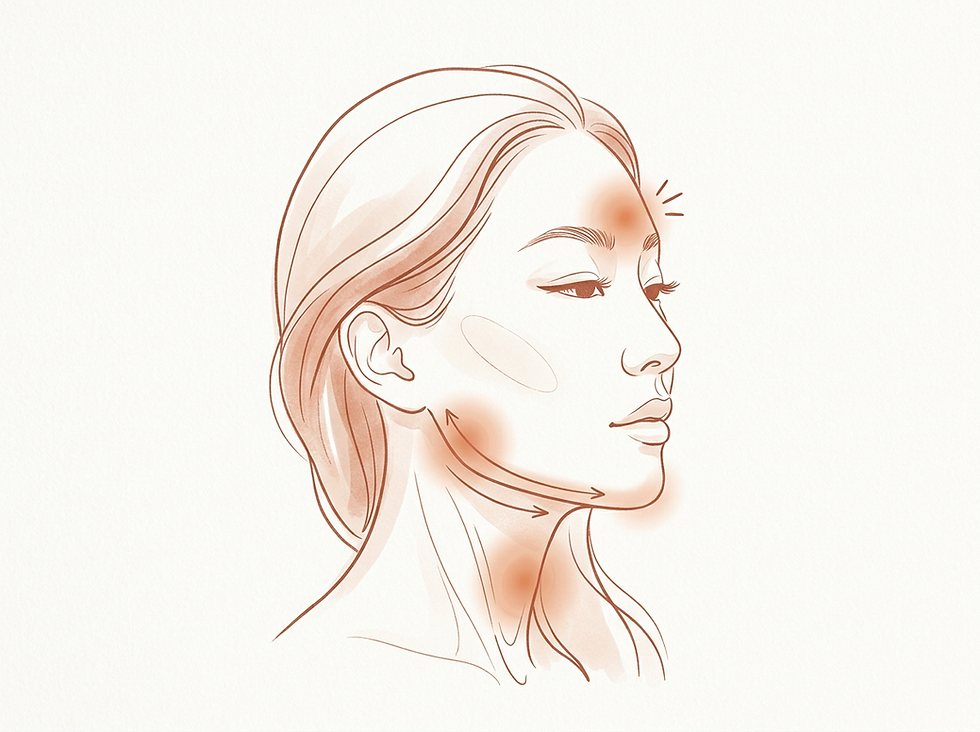
The jaw and lower face are where most stress-related tension accumulates. Jaw clenching and teeth grinding create chronic overactivation of the masseter muscle. An overdeveloped masseter widens and heavies the lower face while simultaneously pulling on the tissue below the chin, contributing to the early appearance of jowling.
The forehead and brow area suffer from a different pattern. Chronic furrowing activates the corrugator muscles between the brows almost continuously. Over years, this repeated contraction pulls the brows downward and inward, creating a heavier, more compressed look around the eyes that no eye cream can lift.
The neck is perhaps the most overlooked site of tension-driven aging. Forward head posture, which is nearly universal among people who use devices regularly, chronically shortens the muscles at the front of the neck while overstretching those at the back. This imbalance compresses the tissue under the chin, weakens the platysma, and directly contributes to the loss of definition in the jaw and neck area.
The temples and scalp hold tension that most people never think about releasing. Tight scalp fascia can actually pull the skin of the forehead and upper face upward and backward, contributing to a stretched, thin quality to the skin in that area over time.
Why Fascia Is the Missing Piece of the Conversation
Most conversations about facial aging focus on collagen, elastin, and skin hydration. These matter. But they are the surface expression of a deeper structural story.
Fascia is the connective tissue matrix that surrounds every muscle, bone, organ, and nerve in the body. In the face, it is what gives the tissue its lift, resilience, and three-dimensional shape. Healthy fascia is hydrated, supple, and mobile. It moves freely and distributes tension evenly so that no single area bears a disproportionate load.
Chronic tension dehydrates fascia. It creates adhesions, places where the connective tissue layers stick together instead of gliding smoothly. These adhesions restrict movement, trap metabolic waste, and reduce circulation to the skin above. The result looks like aging, but it is really restriction. And restriction, unlike aging, can be addressed.
This is why techniques that work with the fascia rather than just the surface of the skin produce such noticeably different results. You are not just moisturizing the outer layer. You are releasing the underlying architecture.
How Tension Release Differs from Facial Training
The previous blog in this series explored structured facial training, the practice of strengthening and lifting through intentional muscle exercise. Tension release is its essential companion and they serve opposite but equally important functions.

Training strengthens muscles that are weak and underused. Release addresses muscles that are overused, shortened, and stuck. Both are necessary for a balanced, lifted face because a face that is strong in some areas and chronically contracted in others will not respond to training the way it should.
Trying to train a face that is full of chronic tension is like trying to build strength on top of a rigid, compressed foundation. The work does not transfer properly. This is why releasing tension is not optional. It is the prerequisite that makes everything else more effective.
Practical Ways to Release Chronic Facial Tension
Building a daily tension release practice does not require much time. What it requires is consistency and a willingness to pay attention to what the face is doing throughout the day.
Start by simply noticing. Set a reminder on your phone once or twice a day to check in with your face. Is your jaw clenched? Are your brows pulled together? Is your tongue pressed to the roof of your mouth or the back of your teeth? Most people are shocked to discover how much tension they are holding without realizing it.
From there, a simple daily release routine can make a significant difference.
Begin with the jaw. Open the mouth as wide as is comfortable, hold for five counts, and slowly close. Repeat five times. Then move the jaw slowly side to side three times in each direction. This deactivates the masseter and releases the surrounding fascia in the lower face.
Move to the forehead. Place your fingertips flat across your forehead with very light pressure. Take a slow breath in and as you exhale, consciously release all the muscles under your fingers. Let the brows drop. Let the forehead soften. Hold for ten counts and repeat three times.
For the neck, slowly drop your chin toward your chest, hold for five counts, then roll the head gently to each side. Follow with the chin-tilt exercise from the facial training routine, which elongates the front of the neck and counteracts the compression from forward head posture.
Finish the release portion of your routine with your facial tool.
How Gloweva Tools Support Fascial Release and Tension Relief
This is where the right tool becomes genuinely transformative rather than just supportive.
Gua sha, when used specifically for tension release rather than lymphatic drainage, applies slightly more deliberate pressure along the muscle belly and connective tissue. The goal is not to push fluid toward lymph nodes but to create a slow, sustained glide that encourages the fascia to soften and release adhesions.
The ULTRA Gua Sha from Gloweva is particularly effective for this purpose. Its broad, flat edge can cover the full length of the jaw muscle, the temporal area along the side of the head, and the planes of the forehead in slow, intentional strokes that reach the connective tissue beneath the skin.
The WING Gua Sha is ideal for the jawline and the area beneath the chin where tension from clenching tends to accumulate and compress. Its curved shape follows the natural contour of the jaw so the tool stays in contact with the tissue throughout each stroke rather than skating across the surface.
For the neck, the Reflex Face Roller provides smooth, even pressure along the sides and front of the neck that encourages muscle release and supports circulation in an area that is chronically compressed in most adults.
On days when tension has caused visible puffiness or redness, the Ice Contour Cube can be used before the gua sha work to calm inflammation and bring the tissue to a more relaxed baseline before release work begins.
You can explore all of these tools at Gloweva.
Small Awareness Habits That Make a Big Difference
Beyond the formal routine, small awareness shifts throughout the day compound into significant long-term change.
Keep lips lightly together and teeth slightly apart when your mouth is at rest. This is the natural resting position of the jaw and it prevents the low-level clenching that most people engage in constantly without realizing it.
When working at a screen, raise it to eye level if possible so the neck is neutral rather than angled downward. Even propping a laptop on a stand can meaningfully reduce the chronic neck compression that contributes to jaw and chin sagging over time.
Breathe through the nose rather than the mouth whenever possible. Nasal breathing supports a natural tongue posture that gently engages the muscles of the midface and jaw in their proper resting position, which over years supports better facial structure.
Take one conscious breath every hour and use it to scan and release your face. Jaw loose. Brow smooth. Tongue resting gently on the palate rather than pressed against the teeth. Shoulders down. This takes five seconds and the cumulative effect over months and years is real.
Frequently Asked Questions
Can facial tension really cause sagging?
Yes. Chronic muscle contraction shortens the muscles and compresses the surrounding fascia, which disrupts the structural support beneath the skin. Over time this creates visible sagging, particularly around the jaw, brow, and neck.
What is the connection between jaw clenching and jowls?
Chronic jaw clenching overactivates the masseter muscle and compresses the tissue in the lower face and beneath the chin. This compression, sustained over years, contributes directly to the loss of jaw definition and the appearance of jowling.
Does gua sha help release facial tension?
Yes, when applied with deliberate pressure along the muscle and fascial lines rather than just the surface of the skin. A stainless steel gua sha tool used in slow, intentional strokes can soften fascial adhesions and encourage muscle release in chronically contracted areas.
How long does it take for facial tension release to show visible results?
Most people notice reduced puffiness and a softer, more relaxed appearance within one to two weeks of consistent daily practice. Structural changes from fascial release tend to become visible after four to six weeks.
Is teeth grinding making my face age faster?
Chronic teeth grinding and jaw clenching are significant contributors to tension-driven aging, particularly in the lower face and neck. Addressing the habit directly, through awareness practices, a nightguard if needed, and daily release work, is one of the most impactful things you can do for the long-term structure of your face.
Let Your Face Breathe
Most of us have spent years telling our faces to hold it together. To look composed, focused, and professional. And our faces have obeyed, quietly storing all of that tension in the muscle and fascia beneath the surface.
Releasing that tension is not vanity. It is maintenance. It is giving your face the same care and attention you give the rest of your body when you stretch, move, and decompress after a long day.
Your face has been working hard. It is time to let it rest, release, and rebuild.
Explore the full range of Gloweva stainless steel tools designed for intentional facial care at Gloweva and find what belongs in your daily ritual.


